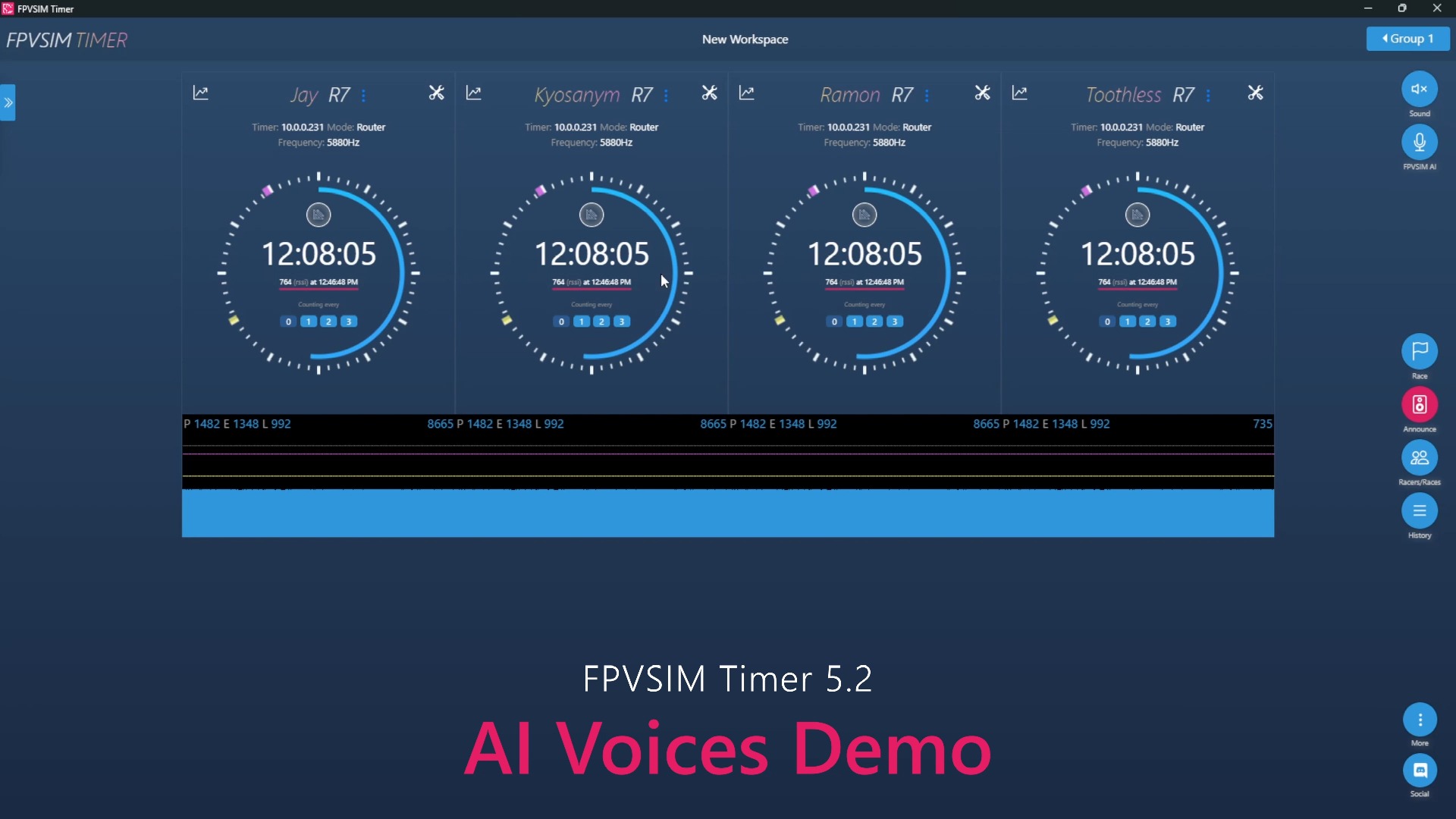
This demonstration introduces the real-time pilot position display of FPVSIM Timer: using a timer network deployed at different locations on the field, the most recently detected position of each pilot is summarized on the same interface. The video uses simulated timing signals to verify the concept, so it is suitable for understanding functional goals; the official event still requires on-site verification for node deployment, network stability, and abnormal data.
What problem does location display solve?
Traditional single-point timing only answers when the pilot passes the start and end points, while the multi-node network can also provide clues about track progress. Event staff can more quickly determine which stage a pilot is in, and it is easier for viewers to understand the sequence of multi-player races. What is shown here is the position status reported by the timing node and should not be equated to a continuous GPS track or centimeter-level positioning.
The value of real-time position depends on whether the node placement is consistent with the track structure. The name, order and corresponding stage of each node must be clear, otherwise although the interface is being updated, the staff may still misunderstand the area where the pilot is.
From simulation demonstration to real competition field
The signal in the video is generated by simulation, which illustrates the interface and data flow direction, and does not prove that it has reached competition-level reliability in a real wireless environment. When landing, you should verify the timer power supply, node networking, clock and event sequence one by one, and test how the interface behaves when missed detections, repeated detections, node disconnections and network delays occur.
It is recommended to first use a single machine to pass each timing point at low speed, confirm the node number and stage mapping, and then increase multi-machine concurrency and normal competition speed. The real-time location page is suitable as competition auxiliary information only after network disconnection recovery, restart and abnormal traffic will not cause an error state that is difficult to identify.
Event usage boundaries
Position display helps with observation and planning, but final results should still be based on proven timing and competition rules. Staff need to retain review methods such as manual observation or video recording, and distinguish the "last detected position" and "current precise position" on the interface to avoid misjudgment that the pending update means the pilot is stuck or lost contact.
FAQ
Is this function equivalent to GPS real-time tracking?
Not equivalent. The video illustrates the position status provided by the timer network, which is closer to the timing node that the pilot recently passed, rather than the continuous coordinate trajectory.
Why do we need to conduct on-site testing before the official competition?
Demonstration uses analog signals. The real track will be affected by node location, power supply, wireless interference, network delay and multi-machine concurrency, and must be verified one by one based on the actual track.
Can real-time position directly determine game results?
It is more suitable as an observation and scheduling aid. Official results shall continue to be determined in accordance with the verified timing procedures and event rules, and review methods shall be retained.
Transcript description
There is no timeline transcript available for publication for this video.
Auto-transcription did not detect credible and understandable speech; this article is only compiled based on video footage and official introduction.