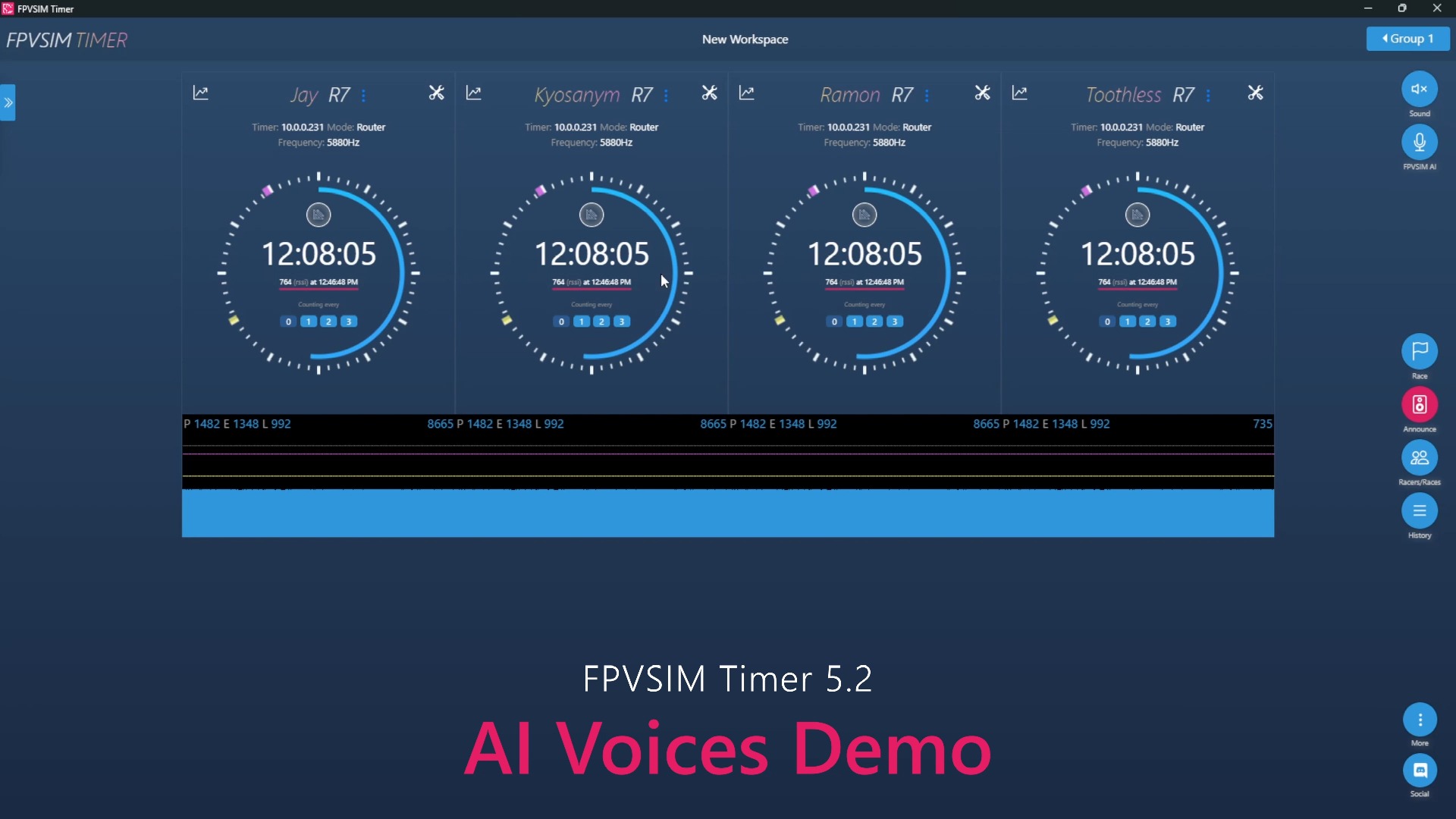
The metronome of the FPVSIM Timer will restart counting after the pilot passes the timing point and broadcast the beat at the set interval of 1, 2 or 3 seconds. It converts the time difference in a single lap into auditory feedback without having to look down at the screen. It is especially suitable for repeatedly comparing different lines, cornering rhythms and maneuvering strategies on the same track.
Use your hearing to establish a lap rhythm
After the pilot passes the timing point, the metronome starts counting from the beginning. Every time you hear the announcement next time, you will know how many set intervals have passed in the current circle. This continuous auditory reference more easily exposes where in the lap a certain line starts to fall behind than just looking at the overall time after completing a lap.
The voice in the video is mainly a continuous digital broadcast, and the functional meaning comes from the release notes. The current demonstration supports three intervals of 1, 2, and 3 seconds; the shorter the interval, the finer the feedback, but the more intensive the broadcast. When practicing, you should choose a rhythm that can distinguish the difference without interfering with control.
How to fairly compare two running styles
First fix the track, model, rates and starting method, and use a familiar route to run a set of stable benchmarks. Then just change one variable at a time, such as cutting off the fuel earlier, changing the entry point, or shortening a section of the line, and see which beats you hear on the same stage. If a smaller count is heard in advance at the same position in multiple repeating circles, it means that the change may be effective.
Don’t draw conclusions from a single best circle. Battery condition, starting differences and occasional mistakes can all change the results. Looking at metronome feedback alongside official lap times, lap time distribution and subjective repeatability can tell whether a certain line is truly faster or just happened to work on a risky try.
Precautions during training
The metronome is a rhythm prompt, not for the pilot to sacrifice safety and stability in order to chase numbers. Familiarize yourself with the reporting method in a simulator or low-risk environment first; if dense speech is distracting, switch to longer intervals. When training with multiple people, you should also make sure that each pilot hears his or her own timing feedback to avoid taking other people's beats as personal progress.
Operation steps
- Select an appropriate beat interval
Start with a longer interval, confirm that the announcement does not obscure important sounds, then adjust to 1, 2 or 3 seconds depending on track length and comparative accuracy.
- Run a repeatable benchmark lap
Keeping the same model, settings and route, complete multiple laps and memorize the beat counts for key stages.
- Only change one running variable at a time
Compare corner entry points, throttle or line changes, and use multi-lap beats and final lap times to judge the effect.
FAQ
When does the metronome start counting again?
According to the video release notes, the metronome resets after the pilot passes the timing point, and then continues counting backwards at the selected interval.
Should I choose 1 second, 2 seconds or 3 seconds?
Short intervals are more detailed, but the speech is more frequent. First choose a longer interval that does not affect control, and then shorten it according to the length of the track and the time difference that needs to be resolved.
Does an earlier beat necessarily mean a faster line?
Not necessarily. Multiple laps should be repeated under the same conditions, and the complete lap time and stability judgment should be combined to eliminate differences caused by starting, battery and accidental mistakes.
Full timeline transcript
Transcripts are arranged according to video time, making it easy to quickly locate the explanation content. Transcript language: English.
34, 36, 38, 3747, 2, 4, 6, 8, 10, 12, 14, 16, 18, 20, 19, 42, 2, 4, 6, 8, 10, 12, 14, 16,
21, 9, 2, 4, 6, 8, 10, 12, 14, 16, 18, 20,