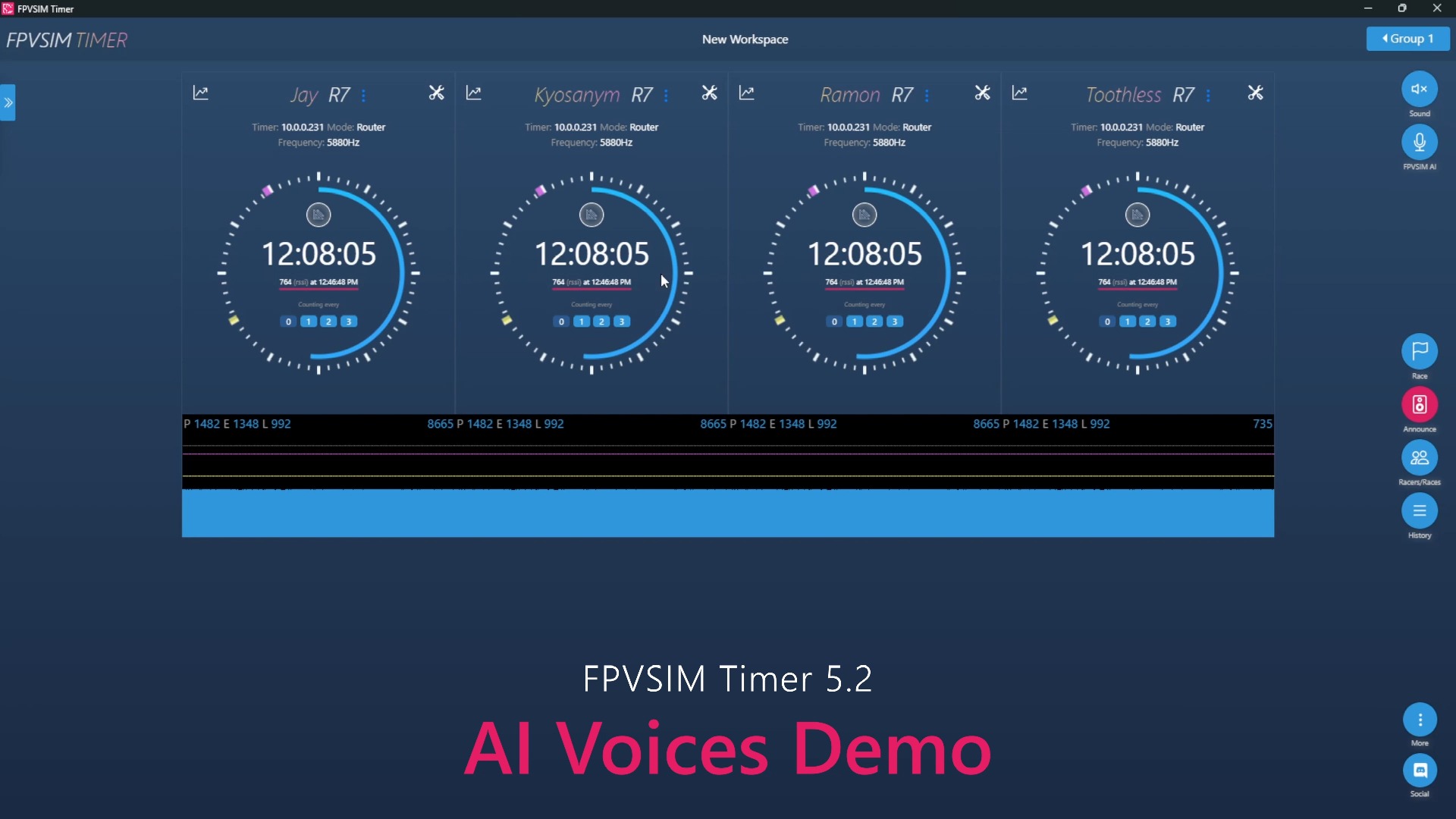
This less than one minute video is an early test record of QuadRank racing timer 2.0. The focus is to observe whether the device can capture the line and send the lap/time to the interface, rather than a complete installation or parameter adjustment tutorial. The video description clearly states that the time displayed in the center of the recorded version is not the real time, and the problem has been fixed after recording; therefore, the numbers in the screen can only be used to understand the test process and cannot be regarded as official results.
What does this short video verify?
The video shows the functional test run before the release of version 2.0: let the aircraft pass through the timing area, observe whether the system generates lap events, and confirm that the interface can be continuously updated. It's more of an acceptance episode during the development phase than a complete tutorial from hardware wiring, channel calibration, to contest creation. If you want to reproduce the test, you should first limit the goal to "test whether it is stable". Don't treat the screen numbers as the final result that can be used for ranking.
Auto-transcription only captures a series of lap time/number broadcasts, without reliable explanation voice. Therefore, this article is only organized based on the testing purpose expressed in the video title, release instructions, and images, and does not expand these numbers into non-existent oral steps.
Correctly understand known issues with recorded versions
Special correction in the release notes: The time in the center of the interface during recording is not the actual timing value. This defect has since been fixed. In other words, the short film can prove that "detection of events and interface updates are working", but it cannot prove the accuracy of the displayed value at that time. When reviewing historical pictures, line crossing detection, data transmission and time display should be divided into three independent links. If any one link is normal, it does not mean that the other two have passed the verification.
The description also mentioned that the official version 2.0 will wait for more testing before being released. This is a development record in 2021, and the current firmware, application entry, calibration method, and interface may be different. Actual use should be based on the current FPVSIM Timer/QuadRank documents and matching versions, and do not copy early interface parameters.
How to conduct reliability verification before the official competition
First fix the timer at the real start and end points, and use the video transmission channel, power, antenna and flight path on the day of the competition to make multiple passes. Record the reactions when crossing the line normally, close to the door, passing quickly and continuously, and circling outside the door, and check whether there are missed laps, repeated lap counting, or long-distance false triggers. Threshold and shortest circle filtering can only be verified in real venues. It is not enough to bring the image transmitter close to the receiver once on the desktop.
The timing display should also be cross-checked with an independent reference, such as a manual stopwatch or repeated testing at known intervals. After completing the stand-alone test, add multiple channels and consecutive competition rounds to confirm that there is no drift in application connection, voice broadcast, save and history records. Only when the three links of detecting events, displaying time and saving results are passed, can the system be suitable for official results.
FAQ
Can the time displayed in the center of the screen be used as a score?
No. The video release notes clearly state that the central time of the recorded version is not the actual timing value, and that the problem was fixed after recording; historical footage can only be used to understand the test status.
Can this video replace the complete installation and calibration tutorial?
No. It is a short test before release and does not fully explain hardware wiring, channel-by-channel threshold calibration, competition configuration and exception troubleshooting. These steps should be completed in conjunction with the current official documentation.
Why is there digital transcription but marked as unreliable explanation?
What is automatically recognized is a lap time or counting broadcast, not a coherent teaching narration. To avoid mistaking the background timing sound for a tutorial, the article only uses the title, description, and verifiable demonstration purpose.
Transcript description
There is no timeline transcript available for publication for this video.
The video does not have a postable tutorial narration; it was automatically recognized as background music or audio unrelated to the tutorial, so it was not displayed as a transcript.