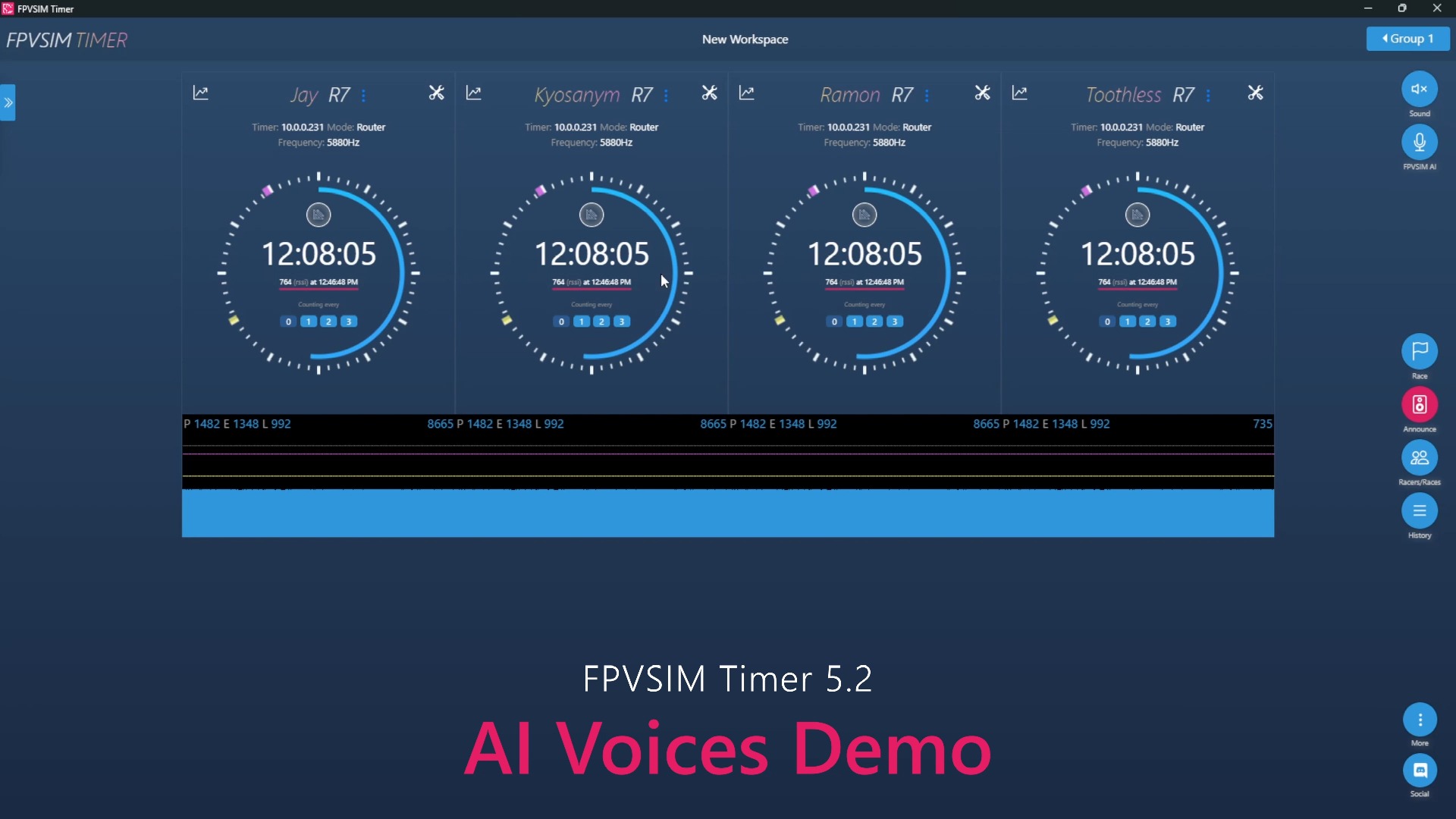
This FPVSIM Timer 3.0 prototype demonstration turns lap time data into instant voice feedback: the system can point out trends such as lap speed improvement, fastest lap and consecutive laps are gradually approaching, and provide encouragement. It’s more like a time-series-based practice reminder than a real-life instructor who can observe the status of lines, strokes, or equipment.
What the “personal coach” prototype actually observed
The video shows a prototype integrated into FPVSIM Timer 3.0 at the time. As the pilot completes laps, the system compares the current lap time with previous records, announces improvements and faster laps, and offers encouragement when performance improves. After about 01:00, the feedback begins emphasizing that several lap times are getting closer together, reflecting the consistency that matters in race training.
The automatic transcript rendered some spoken times inconsistently as 13-1, 17-75, 18-28, and 16-83, so this article does not treat those values as an exact results table. What can reliably be established is the type of feedback: individual lap times, relative improvement, and a trend toward closer lap times. This is a historical prototype demonstration; it does not establish that the current version has the same entry point, voice, or features.
Move from the fastest lap to the distribution of lap times
A fastest lap shows the speed a pilot achieved on one occasion, but does not mean it can be repeated reliably in a race. Looking at several recent laps together reveals whether the average time is falling, the slowest lap is improving, and the gap between fastest and slowest is narrowing. Later in the video, similar times of around 16.77 and 16.92 seconds illustrate why consistent speed deserves more attention than an occasional fast lap.
A practical goal has two stages: first complete enough clean laps to identify a time range you can currently repeat, then aim to keep five consecutive laps within that range. Tighten the target gradually only after achieving it. This avoids frequent errors from chasing a single limit lap and makes the trends and consistency in AI feedback reflect actual training progress.
Lap-time data cannot replace diagnosis of your flight lines
Timing data alone tells the system whether a lap was faster or slower, but not why. A slow lap might result from line choice, turning in too early, throttle on corner exit, a correction after missing a gate, simulator stuttering, or even a temporary change of aircraft or Rates. The video does not demonstrate visual recognition of the course, radio-stick analysis, Blackbox data analysis, or hardware-fault diagnosis.
Treat the feedback as a prompt, not a diagnosis. When the system announces a slower time, the pilot still needs to recall what happened on that lap. To identify a specific action, combine video, stick overlays, observation of the course, or a review with a coach. AI encouragement can help maintain a practice rhythm, but cannot replace safety judgment or human analysis of the causes of mistakes.
Use controlled practice to make trends comparable
For lap-time trends to be meaningful, keep the course, aircraft, Rates, camera angle, and starting procedure as consistent as possible within a practice set, and do not change several parameters at once partway through. Fly a baseline set and record the fastest lap, a typical lap, and the range of times. In the next set, change only one action goal, such as looking toward the exit earlier or reducing overcorrection in a particular turn.
After the second set, compare not only the best time but also the median and the gaps between laps. If the fastest lap improves but variability increases substantially, the new method is not yet consistent. If the fastest lap barely changes but consecutive times get closer, the method may be better suited to racing. Repeating this cycle of a single change followed by testing over multiple laps produces more reproducible training results than chasing every spoken word of encouragement.
Operation steps
- Keep the course and flight settings fixed
Within each comparison, keep the course, aircraft, Rates, camera angle, and starting procedure consistent so lap-time changes do not come from several variables changing together.
- First complete enough clean baseline laps
Fly several consecutive laps to give the system enough data to identify improvements and the fastest lap. The video begins providing immediate lap-time feedback at about 00:04.
- Observe the gaps between consecutive laps
Do not record only the fastest lap; check whether several recent times are getting closer together. The video begins emphasizing consistency feedback after about 01:00.
- Change only one practice focus per set
In the next set, adjust only one line or control goal, then compare the fastest lap, a typical lap, and the range of times. When timing alone cannot explain the cause, review video or stick data.
FAQ
Can this prototype identify the turn where I made a mistake?
That cannot be confirmed from the video. The demonstration uses only lap-time trends, the amount of improvement, and consistency. It does not show course-image, flight-line, stick, or Blackbox analysis.
Why do similar consecutive lap times matter more than one fastest lap?
A single fastest lap may be hard to reproduce. Similar consecutive times indicate more consistent speed and lines, making performance more repeatable in a race.
Can the specific lap times in the video serve as training targets?
Do not copy them directly. The transcript recognizes some numbers inconsistently, and targets depend on the course and configuration. Use your own baseline and lap-time range under fixed conditions.
Is this AI personal coach definitely available now?
The video is explicitly a prototype demonstration from the Timer 3.0 period. Check the latest FPVSIM Timer documentation for current availability, access, and capabilities.
Full timeline transcript
Transcripts are arranged according to video time, making it easy to quickly locate the explanation content. Transcript language: English.
Great job, you've got some solid lap times already, but there's always room for improvement. Keep pushing yourself and keep experimenting with your driving techniques. 13-1 Keep pushing yourself, your progress is impressive and the potential for further improvement is huge. 17-75 Great work on improving your lap times, keep up the excellent effort and you can continue to see even more improvement. 18-28 Keep pushing yourself, because with every lap, you're getting closer to your goal of improving your overall time. 16-83
Your progress is impressive. Keep pushing yourself and you can achieve even better lap times in the future. 1677. Keep going. Keep pushing yourself harder. You've shown significant improvement in your lap times and there's still room for improvement. Let's keep building on that momentum. 1692. It looks like your lap times are getting closer and closer to each other, showing great improvement. Keep up the good work and keep pushing yourself to be faster.